What happened to the "top students" of European economy?
On September 11th, local time, the European Commission released the summer economic forecast report, which predicted that the German economy would shrink by 0.4% this year, making it the only country with negative economic growth among the major EU countries. Coincidentally, in July this year, the International Monetary Fund also predicted that Germany’s GDP would show a negative growth of 0.3% this year, which is the only one among the 22 economies counted. The two major international organizations have made pessimistic forecasts for the German economy this year from the European and global dimensions respectively.

△ Economic growth forecast of major European countries (data from Insight EU Monitoring)

△ Economic growth forecast of the world’s major economies (pictured from the International Monetary Fund IMF official website)
At the turn of the century more than 20 years ago, The Economist magazine in Britain once called Germany the "sick man of Europe". Now the world has to ask this question again. Is Germany the "sick man of Europe"?
There are many problems facing the German economy.
In addition to the GDP growth rate, other economic indicators in Germany are all downward. The business climate index of Ive Economic Research Institute has been declining for four consecutive months. The output value of chemical products in Germany’s major industrial products decreased by 18% compared with 2019, and the output value of automobiles decreased by 26%. In July this year, Germany’s exports to non-EU countries decreased by 2.9% month-on-month, and the trade surplus fell to 82 billion euros, a sharp drop of 60% compared with 200 billion euros before the epidemic. In the first six months of this year, 8,400 enterprises filed for bankruptcy in Germany, an increase of 16.2% over the same period last year. The Annual Report on World Competitiveness published by the International Institute for Management Development in Lausanne, Switzerland, has reduced the ranking of Germany’s competitiveness from the sixth place in the world to the 22nd place.
High inflation, high interest rates and weak external market demand are the main reasons that lead to Germany’s deep sinking. High inflation causes enterprises to increase production costs and reduce household consumption, while high interest rates suppress investment and lending, and the decrease in external market demand directly hits Germany’s import and export trade. These three major causes seem to be pressure from outside Germany, but the Germans themselves seem helpless in the face of pressure.

German economist Thomas MeyerIn the face of high interest rates and high energy prices, Germany’s manufacturing industry has been hit harder than the service industry. For example, producing a car requires a lot of energy; Or steelmaking and machining, also need energy. At the same time, when the interest rate is high, people’s consumption will also be limited. In contrast, the service industries in other countries are less sensitive to energy prices and high interest rates.
The British "Economist" published an article on August 17, pointing out that over the years, Germany’s excellent performance in the traditional industrial field concealed its lack of investment in new industries. Complacency and obsession with fiscal prudence lead to too little public investment. Overall, the proportion of information technology investment in GDP in Germany is less than half that in the United States and France. In addition, there are worsening geopolitics, the difficulty of reducing carbon and the pain caused by the aging population.
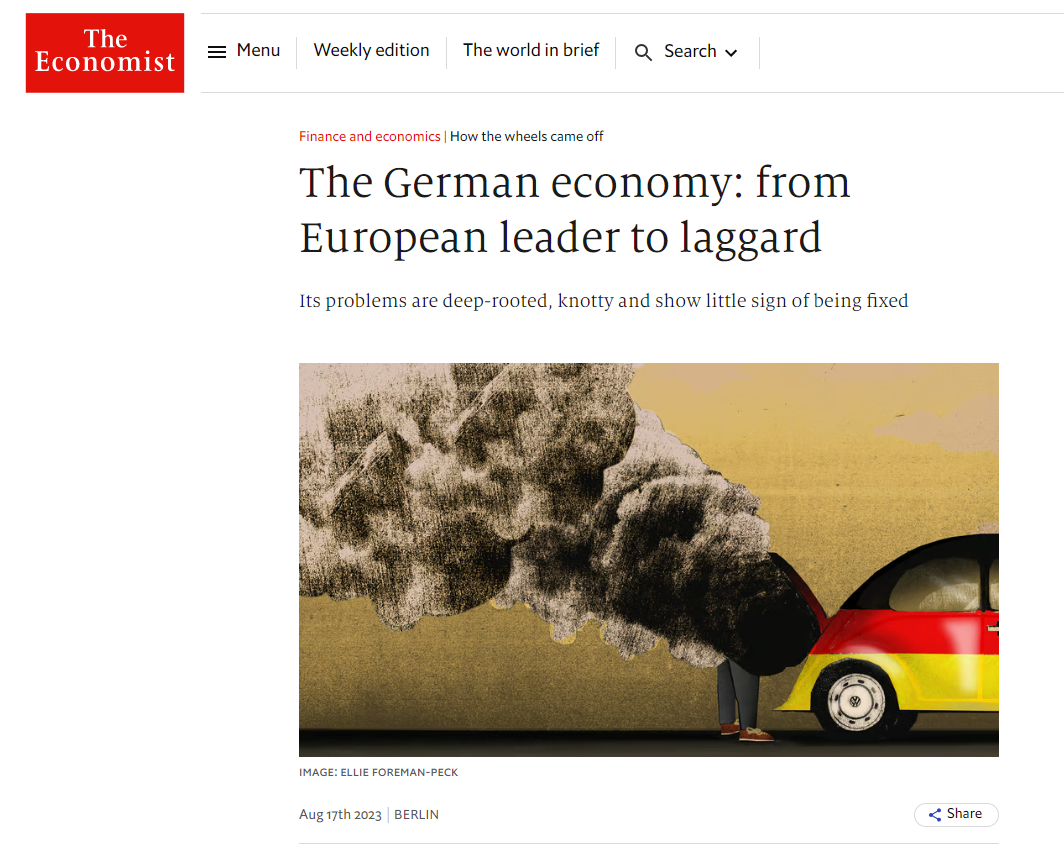
△ British "Economist" report screenshot
All walks of life in Germany are suffering from the economic downturn.
Since the fourth quarter of 2022, the German economy has declined or stagnated for three consecutive quarters. The German Federal Bank (the central bank) released a report at the end of August, predicting that the German economy will still have zero growth in the third quarter of this year. Faced with this grim situation, the German federal government has so far failed to introduce substantive stimulus measures, but the German people and enterprises have deeply tasted the bitter taste of economic downturn. According to the latest poll released by the authoritative German polling agency Fossa Institute of Public Opinion on September 10th, 46% of Germans think that their life will be worse in ten years. 32% people think their situation will remain unchanged; Only 17% people believe that they will live a better life in the future.
Michael Vic, vice president of the German Bakery Association, runs a 387-year-old coffee shop, and his bakery now pays four times the original electricity bill. He noticed that many of his colleagues were forced to close their stores this year because they could not make ends meet and could not continue to operate. Vic is deeply worried about the stagnation of the German economy.

Michael Vic, Vice President of German Pastry AssociationWe can’t make up for the loss entirely by raising prices, because high inflation has suppressed people’s desire for consumption, and people are more cautious when spending money. However, the federal government has not provided necessary support and help to small and medium-sized enterprises, and there is nothing we can do about it. All this has caused the handicraft industry to struggle.
Sukorowski, general manager of German glass processing enterprises, also said: "The federal government must formulate clear and definite regulations on the financial support plan, and the energy policy should be lasting and stable. At the same time, we must protect the European economy and producers while maintaining the Asian market."

△ Screenshot of a German TV news report
The remedy for Germany’s economic difficulties
More than 20 years ago, when the British mocked Germany as the "sick man of Europe" for the last time, the Germans successively elected two governments, Schroeder and Merkel, and adopted a series of pragmatic and effective economic policies. On the one hand, they repaired with neighboring countries to obtain cheap energy supplies, and at the same time, they vigorously explored the China market to find markets and outlets for German industrial products, thus promoting the steady growth of the German economy for 20 years. Germany became the locomotive of European economy, and led the EU through the two major hurdles of American subprime mortgage crisis and European debt crisis.
Nowadays, the external and internal environment in which Germany is located has changed compared with the beginning of this century, but the basic structure of the German economy has not changed. The economic development of Germany, which is based on industry, is still inseparable from cheap energy, raw material supply and broad external market. The successful experience of the former government is still the right medicine and the key to win the German economy out of trouble.
Producer: Jiang Qiuyong
Editor Liang Mao
Reporter Tao Ye Ruan Jia Wen