2050 China: People-centered socialist modernization in an all-round way

Abstract: The general task and strategic deployment of socialist modernization in the first half of the 21st century can be divided into three steps: the first step is to build a society of common prosperity in an all-round way in 2030; The second step is to build a society of common prosperity in an all-round way by 2040; The third step is to realize socialist modernization in an all-round way by 2050. China’s modernization is essentially a people-centered all-round development modernization, which has four basic factors, namely, modernization, socialism, China and green. The way to realize the general goal of a socialist modernized country is to realize the modernization of the six-in-one centered on human modernization. By the middle of the 21st century, China will make economic, innovative, green, cultural and global governance contributions to human development.

[Keywords:] China; 2050; Modernization; general task

From a historical perspective, the general task and strategic deployment of socialist modernization in the first half of the 21st century can be roughly divided into three steps: the first step is to build a society of common prosperity in an all-round way in 2030; The second step is to build a society of common prosperity in an all-round way by 2040; The third step is to realize socialist modernization in an all-round way by 2050. We must insist that China’s modernization is essentially a people-centered all-round development modernization with four basic factors, namely, modernization, socialism, China and green. It should be noted that the way to achieve the overall goal of a socialist modernized country is to realize the modernization of the six-in-one centered on human modernization. By the middle of the 21st century, China will make economic, innovative, green, cultural and global governance contributions to human development.

First, the strategic vision of China’s socialist modernization

Based on Mr. Zhang Peigang’s definition of industrialization, [1] we define modernization as: "the whole society, a series of modern elements and the combination of continuous breakthrough changes or changes from low to high." Therefore, modernization is a historical and developing concept, which has no fixed model or the only way, and is not equal to westernization. The modernization road of any country is different, and China’s modernization road is bound to be unique. Modernization is the modernization of the whole society, which includes five aspects: economic modernization, social modernization, political modernization, cultural modernization and ecological civilization modernization, especially human modernization, including the modernization of all people, including cities and rural areas, different regions and ethnic minorities. Modernization has both stages of development and qualitative change. As far as the development of China is concerned, from poverty to food and clothing, from initially reaching a well-off level to finally building a well-off society, this is an accumulation from quantitative change to qualitative change. Modernization is also an all-round process of change, which includes changes in ideas, economy, society and culture, and is essentially the modernization of the national governance system and governance capacity.

After the reform and opening up, the goal of China’s modernization has gradually deepened. The party first put forward the strategic idea of "two steps" and then put forward the strategic idea of "three steps". What is the 2050 goal? In the report of the 13th National Congress of the Communist Party of China in 1987, it was pointed out that by the middle of the 21st century, the per capita GNP would reach the level of moderately developed countries, people’s lives would be relatively affluent and modernization would be basically realized. In the report of the 18th National Congress of the Communist Party of China in 2012, it was put forward that a prosperous, strong, democratic, civilized and harmonious socialist modern country should be established in the centenary of the founding of New China.

The party’s layout of China’s socialist modernization has gradually expanded, from economic construction to the "four-in-one" overall layout proposed by the 17th National Congress of the Communist Party of China, and then to the "five-in-one" overall layout of economic, political, cultural, social and ecological civilization proposed in the report of the 18th National Congress of the Communist Party of China in 2012. In this way, the overall layout of China’s modernization basically took shape in the first half of the 21st century (2000-2050).

The overall layout of China’s modernization was not completed at one time, but was perfected after continuous understanding, repeated practice, exploration and innovation. From economic modernization to overall modernization, from material modernization to human modernization. From this point of view, China’s "five in one" modernization has surpassed the western modernization marked by economic and material modernization. China’s modernization road also provides important experience and reference for the southern countries to innovate and realize modernization.

Second, China’s "Three Steps" by 2050

The 18th National Congress of the Communist Party of China emphasized that the overall basis for building Socialism with Chinese characteristics is the primary stage of socialism. This historical period can be divided into "first half" and "second half". The second half of the 20th century is the "first half" of the primary stage of socialism, and China has experienced two stages of development: one is the stage of absolute poverty, which is the stage of laying the foundation at the level of extreme poverty, that is, the stage of socialist construction; Second, the economic take-off stage of reform and opening-up, which has experienced the stage of food and clothing and the stage of well-off level. Entering the 21st century is the "second half" of the primary stage of socialism, which has gone through two stages: one is the stage of sustained high growth (well-off society) in the first 20 years, realizing the first century goal, that is, basically realizing the industrialization goal; The second is the stage of sustained and stable growth (common prosperity) in the last 30 years, and the goal of the second century, that is, the goal of socialist modernization in an all-round way.

After building a well-off society in an all-round way in 2020, how to achieve the goal of the second century? What kind of strategic deployment and development path should be adopted? To achieve this goal, we must work hard for a long time step by step. The theme of China’s modernization is still socialist modernization, and the key word is still "comprehensive". There are inheritance, continuity and stages between this and building a well-off society in an all-round way.

The general task and strategic deployment of socialist modernization can be roughly divided into three steps, forming three comprehensiveness.

The first step is to build a society of common prosperity in an all-round way by 2030. As Deng Xiaoping said, "We stick to the socialist road, and the fundamental goal is common prosperity". After 2020, the theme of China’s socialist modernization is that all people will build a common and prosperous society in an all-round way under the leadership of the Communist Party of China. After 50 years of reform and opening up, the time is ripe and conditions are met to achieve this goal. Common prosperity is not the same as average prosperity. The so-called affluence requires that China’s per capita income level, human development level and major modernization indicators reach the forefront of middle-and high-income countries in the world; The so-called common prosperity requires public services and social security to cover the whole population, and the gap between regions, urban and rural areas and income continues to narrow; The so-called socialist modernization power requires that China’s main indicators occupy the first place in the world and become a multi-faceted power in the world in terms of economy, human resources, innovation, culture and comprehensive national strength.

The second step is to build a society of common prosperity in an all-round way by 2040. A high level of affluence requires that China’s per capita income level, human development level and major modernization indicators approach or reach the level of moderately developed countries in the world, and basically realize modernization; Building a common and prosperous society in an all-round way requires high-level public services and social security to cover the whole population, and the gap between regions, urban and rural areas and income continues to narrow. China will have a strong comprehensive national strength and a more prominent position in the world.

The third step is to realize socialist modernization in an all-round way by 2050. This is the logic and stage of modernization with the comprehensive construction of a well-off society, a comprehensive construction of a society with common prosperity and a comprehensive construction of a society with common prosperity.

After that, China will enter the intermediate stage of socialism, which may take several decades. To this end, we can consider and put forward the goal of the third century, that is, to build a highly developed socialist modern country by the 100 years of reform and opening up (2078), which constitutes an important goal to realize the great rejuvenation of the Chinese nation.

Now, the most important thing is to focus on the first step. According to the spirit of the report of the 19th National Congress of the Communist Party of China, plan the 14th Five-Year Plan, establish clear development goals, and create a good start for achieving the goal of the second century.

III. China in 2050: People-centered Comprehensive Modernization

In terms of modernization factors, the realistic goal of China’s socialist modernization is to catch up with and surpass the modernization level of developed countries, but more importantly, it embodies the road characteristics and advantages of China Road. In essence, it is a kind of transcendence and innovation, and it creates a modernization mode that is completely different from and superior to traditional western capitalism.

China’s modernization is Socialism with Chinese characteristics’s modernization, and its essence is people-centered all-round development modernization. It has four basic factors: modernization, socialism, China and green, and they work together to promote people-centered modernization.

Comrade Supreme Leader’s "people-centered" development thought contains five connotations. First, development is for people’s freedom and all-round development, which is also the goal of Marxism. Secondly, the essence of modernization is people’s modernization, and material modernization serves people’s modernization. Third, people are the main body of development. Fourth, the fundamental driving force for development is to mobilize people’s enthusiasm and creativity. Fifth, the fruits of development are shared by all the people. This is the theoretical basis and ideological soul for realizing China’s socialist modernization.

Socialism with Chinese characteristics’s modernization has four basic factors: first, developed modernization, which has all the modernization factors in the world; Second, the modernization of socialism, with more advanced socialist factors superior to capitalism, is jointly built, shared and shared by all the people; Third, China has its own characteristics, with China’s unique road theory system and cultural factors, which are shared by the Chinese nation; Fourth, the green modernization of China’s ecological civilization, "establishing the concept of respecting nature, conforming to nature and protecting nature", provides ecological products and services for contemporary people, ecological wealth for future generations and ecological security for the whole world.

China’s socialist modernization is essentially the modernization of man’s all-round development, which is based on Constitution of the Communist Party of China. It includes modernization at individual, social, national and global levels. From the perspective of human beings, it fully embodies Marx’s thought of all-round development of human beings. From a social perspective, it is to build a developed society of common prosperity. From the national level, it is to build a socialist modernization power. From a global perspective, it is to become an advocate, practitioner and leader of the community of human destiny.

IV. China in 2050: Overall Goals and Tasks

The overall goal of 2050 is to build a prosperous, strong, democratic, civilized, harmonious and green socialist modern country in an all-round way. This is not only the all-round development of people, but also the all-round development of more than one billion people. According to the six-in-one overall layout, China puts forward the goal and index system of China modernization in 2050. This system includes six aspects: economy, politics, society, culture, ecological civilization, national defense and military modernization.

The overall goal is to build a prosperous, democratic, civilized, harmonious and green socialist modern country in an all-round way by 2050. It includes six main goals: first, to build a socialist modern country with a rich people and a strong country. Second, build a socialist democratic and modern country. Third, build a better and more civilized socialist modern country. Fourth, build a more harmonious socialist modern country. Fifth, build a greener socialist modern country. Sixth, build a country that has made great contributions to human development. From the core indicators, the overall layout of the six-in-one has shifted from GDP as the center to the all-round development of people (see Figure 1). First, from the perspective of economic construction, we no longer aim at pursuing high growth, but aim at sustained, healthy and stable economic growth, and only stipulate the bottom line of economic growth. Second, from the perspective of social construction, we should focus on improving people’s livelihood and promote social construction in an all-round and balanced way, with human development indicators as one of the core indicators. Third, from the perspective of ecological construction, we should focus on people’s livelihood environment, focus on solving environmental problems such as water, gas, sound and soil that people care about, and focus on solving environmental problems closely related to people’s interests such as non-point source pollution, drinking water safety and ecological poverty in rural areas. Fourth, from the perspective of cultural construction, we should focus on promoting people’s cultural construction. People are not only the main body of cultural consumption, but also the main body of cultural creation and participation. Fifth, from the perspective of political construction, we should promote democracy with people’s livelihood and promote people’s livelihood with democracy. Sixth, from the perspective of national defense construction, it is necessary to ensure national security.Ensure that the army is a people’s army that listens to the party’s command, can win battles, and has a good style of work.

next page

The Ministry of Education and the Ministry of Science and Technology issued a document requesting universities to standardize the use of relevant indicators of SCI papers.

  Recently, the Ministry of Education and the Ministry of Science and Technology issued "Several Opinions on Standardizing the Use of Relevant Indicators of SCI Papers in Colleges and Universities and Establishing Correct Evaluation Orientation" (hereinafter referred to as "Opinions"), which put forward clear requirements for breaking the "SCI supremacy" of papers.

  "Colleges and universities should take breaking the paper" ‘SCI first "as a breakthrough, make a small incision and make a big turn, come up with practical and hard moves with strong pertinence and operability, break the" only paper "and establish a correct evaluation orientation." The head of the Science and Technology Department of the Ministry of Education said.

  The related indexes of SCI papers are directly used for scientific research evaluation, which has great limitations.

  The General Secretary of the Supreme Leader clearly pointed out at the National Education Conference that it is necessary to deepen the reform of the education system, improve the implementation mechanism of moral education, reverse the unscientific orientation of education evaluation, resolutely overcome the stubborn disease of only grades, only studies, only diplomas, only papers and only hats, and fundamentally solve the baton problem of education evaluation.

  In recent years, there is a strong voice from all walks of life to break the "SCI supremacy" of papers and optimize academic ecology. "The related indicators of SCI papers have become the core indicators of academic evaluation, professional title evaluation, performance appraisal, talent evaluation, subject evaluation, resource allocation, school ranking, etc., which makes the scientific research work of colleges and universities excessively pursue the related indicators of SCI papers, and even the alienation with the basic goal of publishing the number of SCI papers, high-impact papers and highly cited papers, and scientific and technological innovation has problems such as distorted value pursuit, exaggerated and impetuous style of study and quick success." The "Opinions" pointed out.

  According to reports, SCI is a widely used index system of scientific and technological documents at home and abroad. Just like the book classification card in the library, as a classified database, it helps scientific and technological workers to consult the latest documents, track academic frontiers and carry out scientific research by counting the research fields, directions and cited frequencies of papers.

  "The relevant indicators of SCI papers are directly used for scientific research evaluation, which has great limitations." The person in charge of the Science and Technology Department of the Ministry of Education introduced that the essence of SCI is a document indexing system, not an evaluation system, and SCI papers cannot be simply equated with high-level papers. The number of citations reflects the attention of papers, but not the innovation level and substantive contribution. A high number of cited papers means more academic research hotspots. At the same time, the relevant indicators of SCI papers can not fully reflect the contribution of scientific and technological innovation, and are not suitable for the evaluation of technological innovation and achievement transformation.

  Breaking the "supremacy of SCI" is not to deny SCI, nor to oppose the publication of papers.

  What are the specific measures to standardize the use of related indicators of SCI papers in colleges and universities? The Opinions lists a "negative list":

  Improve discipline and school evaluation. Reduce the ranking evaluation of disciplines and schools, and adhere to classification and field evaluation. In the evaluation, we should highlight the quality of innovation and actual contribution, carefully select quantitative indicators such as the number of SCI papers, and guide social institutions to scientifically carry out university evaluation rankings.

  Optimize the evaluation and employment methods of professional titles (positions). In the evaluation and employment of professional titles (positions), it is necessary to establish a classified evaluation index system, focusing on the suitability of people and posts, and not taking the relevant indicators of SCI papers as the direct basis for the evaluation and employment of professional titles (positions) and as the precondition for the employment of personnel.

  Reverse the utilitarian tendency of assessment and reward. It is not appropriate for schools to set requirements for academic departments and individuals’ paper indicators, and to remove the direct link between related indicators of SCI papers and resource allocation and performance rewards.

  Scientifically set quality standards for degree awarding. Guide schools to set reasonable quality standards for degree awarding according to the characteristics of disciplines, and it is not appropriate to take the number of published SCI papers and influencing factors as restrictive conditions for students’ graduation and degree awarding.

  Establish a correct policy orientation. Colleges and universities and their competent departments should shoulder the responsibility of leading the construction of academic culture, have confidence and determination, and do not accept the letter in public opinion propaganda, and do not publish information such as rankings compiled with the relevant indicators of SCI papers as the core.

  Then, after the publication of the Opinions, does it mean that papers will no longer be read in various reviews in the future?

  "This understanding is wrong. The introduction of the document breaks the paper’ SCI supremacy’, not denying SCI, nor opposing the publication of the paper." The person in charge of the Science and Technology Department of the Ministry of Education clearly stated that papers are a manifestation of scientific and technological innovation achievements and an important carrier of academic exchanges. We encourage the publication of academic papers with high level, high quality, innovative value and service contribution. However, in academic evaluation, the innovation level can not be judged simply by the relevant indicators of SCI papers; In all kinds of evaluation activities, it is necessary to rationally use relevant indicators and adopt a comprehensive evaluation method combining qualitative and quantitative methods to guide the evaluation work to highlight scientific spirit, innovative quality and service contribution.

  Scientific evaluation of academic level, different types of scientific research evaluation do not engage in "one size fits all"

  How to scientifically evaluate the academic level is a complex problem, and different types of scientific research work can not be "one size fits all".

  The "Opinions" pointed out that for basic research, papers are the main expression form of results output, and "judging papers by journals" is resolutely abandoned. The evaluation focus is on the innovation level and scientific value of papers, and the relevant indicators of SCI papers are not used as the direct judgment basis; For applied research and technological innovation, the evaluation focuses on the actual contribution to solving key technical problems in production practice, and the actual effect of bringing new technologies, new products and new processes to realize industrial application, instead of taking the paper as a single evaluation basis; Papers are generally not used as evaluation indicators for scientific research and transformation of scientific and technological achievements serving national defense.

  "We should improve the academic peer evaluation and really play the role of peer experts. In the evaluation, guide experts to not simply replace professional judgment with relevant indicators of SCI papers, provide professional evaluation opinions responsibly, and advocate the establishment of a reputation system for evaluation experts. " The person in charge of the Science and Technology Department of the Ministry of Education introduced that the next step is to greatly reduce the "three evaluations" such as project evaluation, talent evaluation and institutional evaluation. The evaluation indicators and methods should be fully listened to, and the evaluation methods should be representative evaluation, and the application materials should be streamlined and optimized. It is no longer required to fill in the relevant indicators of SCI papers.

  The reporter noted that some of the Opinions were expressed as "not allowed", such as "not directly linked to SCI related indicators when allocating resources"; Some statements are "inappropriate", such as "it is not appropriate for schools to issue quantitative requirements for related indicators of SCI papers to departments and individuals in performance and employment period assessment".

  The person in charge of the Science and Technology Department of the Ministry of Education introduced that the use of "no" in terms of utilitarian tendencies means that it is explicitly prohibited and resolutely abandoned existing practices; The use of "inappropriate" is based on the fact that there are still great differences in the development level of colleges and universities in China, and the characteristics and requirements of different disciplines are also different, giving schools certain policy flexibility. For example, in the document, "the number of published SCI papers and impact factors should not be used as restrictive conditions for students’ graduation and degree awarding", which indicates that it is opposed to making rigid regulations at the school level. However, in the process of talent training, it is reasonable for tutors and departments to put forward corresponding requirements for students from the perspective of scientific research ability training and scientific research practice training, which is also in line with the needs of talent training.

  "The Ministry of Education will inspect the clean-up and rectification of all units through supervision and other means. For units that do not carefully check, refuse to rectify, and have serious problems, they must adopt interviews, informed criticism, etc., and pursue leadership responsibilities. " The head of the Science and Technology Department of the Ministry of Education said. (Reporter Zhang Shuo)

The latest bulletin of Jiangsu Provincial People’s Government Statistical Bulletin of National Economic and Social Development of Jiangsu Province in 2021

Statistical Bulletin on National Economic and Social Development of Jiangsu Province in 2021

Jiangsu province statistics bureau national bureau of statistics Jiangsu survey corps

In 2021, the whole province will adhere to the guidance of Socialism with Chinese characteristics Thought of the Supreme Leader in the New Era, conscientiously implement the decision-making arrangements of the CPC Central Committee and the State Council and the requirements of the provincial party committee and government, adhere to the general tone of striving for progress while maintaining stability, and do a good job in the work of "six stabilities" and "six guarantees", effectively cope with the complicated and changeable external environment and various risk challenges, reach a new level in comprehensive strength, achieve new breakthroughs in structural transformation, demonstrate new advantages in development momentum, and make new progress and high achievements in building a new development pattern.

First, integration

The economic aggregate has leapt to a new level. According to preliminary accounting, the annual GDP reached 11,636.42 billion yuan, reaching a new level of 11 trillion yuan, an increase of 8.6% over the previous year. Among them, the added value of the primary industry was 472.24 billion yuan, an increase of 3.1%; The added value of the secondary industry was 5,177.54 billion yuan, an increase of 10.1%; The added value of the tertiary industry was 5,986.64 billion yuan, an increase of 7.7%. The proportion of three industrial structures in the whole year is 4.1:44.5:51.4. The province’s per capita GDP was 137,039 yuan, an increase of 8.3% over the previous year. The economic vitality was enhanced, and the added value of the non-public sector of the economy reached 8,762.22 billion yuan, accounting for 75.3% of GDP, an increase of 0.4 percentage points over the previous year; The added value of private individual economy accounts for 53.2% of GDP, and the added value of private economy accounts for 57.3% of GDP. At the end of the year, there were 3.574 million private enterprises registered by the industrial and commercial departments, and 640,000 private enterprises were newly registered throughout the year; At the end of the year, there were 9.51 million self-employed households and 1.848 million newly registered self-employed households. The regional economic development is strongly supported. The Yangtze River urban agglomeration contributes 76.9% to the province’s economic growth, and the coastal economic belt contributes 18.1% to the province’s economic growth.

Emerging kinetic energy continues to grow. In the whole year, the output value of industrial strategic emerging industries and high-tech industries accounted for 39.8% and 47.5% respectively, increasing by 3 and 1 percentage point respectively over the previous year. The operating income of the regulated high-tech service industry increased by 18.1% year-on-year, contributing 32% to the growth of the regulated service industry in the province. Investment in high-tech industries increased by 21.6% over the previous year, which was 15.8 percentage points higher than the total investment. Digital empowerment is powerful. The added value of digital products manufacturing industry in gauge industry increased by 19.7% over the previous year, which was 6.9 percentage points higher than that in gauge industry. According to the regulations, the operating income of Internet and related services in the service industry increased by 27.5% over the previous year.

The employment situation remained generally stable. In 2001, 1.402 million new jobs were created in cities and towns, an increase of 74,000 over the previous year and a year-on-year increase of 5.6%. The unemployment rate in urban survey should be controlled within the expected target. Efforts were made to ensure the employment of key groups. The employment rate of college graduates at the end of the year was 95.6%, and 54,000 people with employment difficulties were resettled in newly developed public welfare posts. We promoted the "Creating a Sound in Jiangsu" series of activities, supported 397,000 successful independent entrepreneurs, and the entrepreneurial multiplier effect continued to be released.

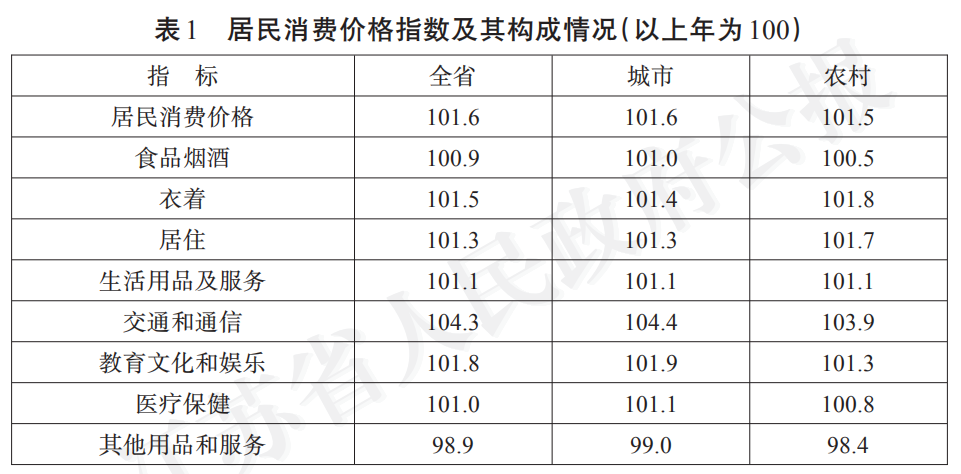
Consumer prices rose moderately. The annual consumer price rose by 1.6% over the previous year, including 1.6% in cities and 1.5% in rural areas. By category, food, alcohol and tobacco rose by 0.9%, clothing by 1.5%, residence by 1.3%, daily necessities and services by 1.1%, transportation and communication by 4.3%, education, culture and entertainment by 1.8%, medical care by 1.0% and other supplies and services by 1.1%. Among foods, grain rose by 0.8%, edible oil by 6.3%, fresh vegetables by 6.8%, aquatic products by 14.0%, eggs by 12.5% and livestock meat by 15.0%. The ex-factory price of industrial producers rose by 6.3% over the previous year, and the purchase price of industrial producers rose by 13.8%.
  

While seeing remarkable achievements in economic and social development, we should also be soberly aware that the current situation of epidemic prevention and control is still grim, the market demand is still weak, the development of some industries, especially small and medium-sized enterprises, is still difficult, and the stability of the industrial chain supply chain is under great pressure. The problem of "sticking the neck" in many key areas is still outstanding, the foundation of independent and controllable modern industrial system is still not solid enough, there are still many shortcomings in people’s livelihood fields such as education, medical care, old-age care and child-rearing, and there are still some potential risks in some areas.

Second, agriculture, forestry, animal husbandry and fishery

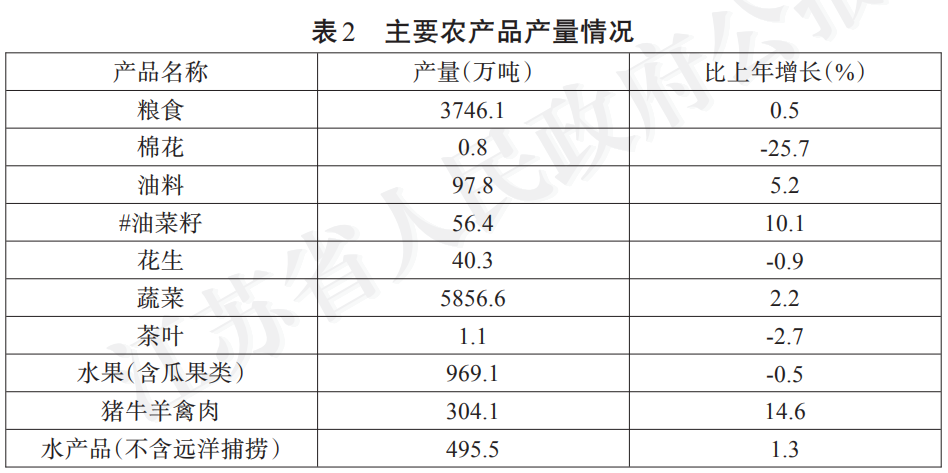
The planting structure was continuously optimized. The annual grain planting area was 5.428 million hectares, an increase of 22,000 hectares over the previous year; The cotton planting area was 0.6 million hectares, a decrease of 0.3 million hectares; The oil planting area is 296,000 hectares, an increase of 18,000 hectares; The vegetable planting area was 1.453 million hectares, an increase of 0.9 million hectares. The comprehensive agricultural production capacity continued to increase, and the total grain output reached a new high of 37.461 million tons, an increase of 170,000 tons or 0.5% over the previous year. Among them, summer grain was 13.807 million tons, an increase of 0.5%; Autumn grain was 23.654 million tons, an increase of 0.4%. The grain yield per mu was 460.1 kg, an increase of 0.2 kg or 0.1% over the previous year.

Forestry, animal husbandry and fishery production are generally stable. The annual afforestation area is 11,000 hectares. The annual output of pigs, cattle, sheep and poultry was 3.041 million tons, an increase of 14.6% over the previous year; The output of poultry eggs was 2.303 million tons, down by 0.7%; The total output of milk was 649,000 tons, an increase of 3.1%. The total output of aquatic products was 4.955 million tons (excluding offshore fishing), up by 1.3% over the previous year, including 3.667 million tons of freshwater products and 1.288 million tons of seawater products, up by 3.2% and down by 3.9% respectively.

Modern agriculture has developed rapidly. The province has built 3.9 million mu of high-standard farmland, and the comprehensive mechanization rate of crop cultivation and harvest exceeds 83%, which is nearly 11 percentage points higher than the national average. The province’s effective irrigation area reached 4.232 million hectares, with an additional effective irrigation area of 0.8 million hectares.
III. Industry and Construction Industry

Industrial production resumed steadily. The added value of industrial enterprises above designated size increased by 12.8% over the previous year, including light industry by 12.4% and heavy industry by 12.9%. In terms of economic types, the added value of state-owned holding enterprises increased by 7.9%, collective enterprises by 8.2%, joint-stock enterprises by 14.4%, foreign-invested enterprises from Hong Kong, Macao and Taiwan by 10.7% and private enterprises by 15.5%. In terms of categories, the mining industry increased by 2.1%, the manufacturing industry increased by 12.8%, and the electricity, heat, gas and water production and supply industries increased by 12.8%.

The advanced manufacturing industry is growing well. The added value of high-tech industry and equipment manufacturing industry in the province increased by 17.1% and 17.0% respectively over the previous year, which was 4.3 and 4.2 percentage points higher than that of industries above designated size. The contribution rate to the increase of industrial added value reached 30.5% and 67.3%. By industry, the added value of advanced manufacturing industries such as electronics, medicine, automobiles and special equipment increased by 17.3%, 11.0%, 14.7% and 15.9% respectively. The output of new products representing intelligent manufacturing, new materials, new transportation equipment and high-end electronic information products has achieved rapid growth. The output of new products such as new energy vehicles, urban rail vehicles, 3D printing equipment, integrated circuits and servers increased by 198%, 5.9%, 64.3%, 39.1% and 67.3% respectively over the previous year.
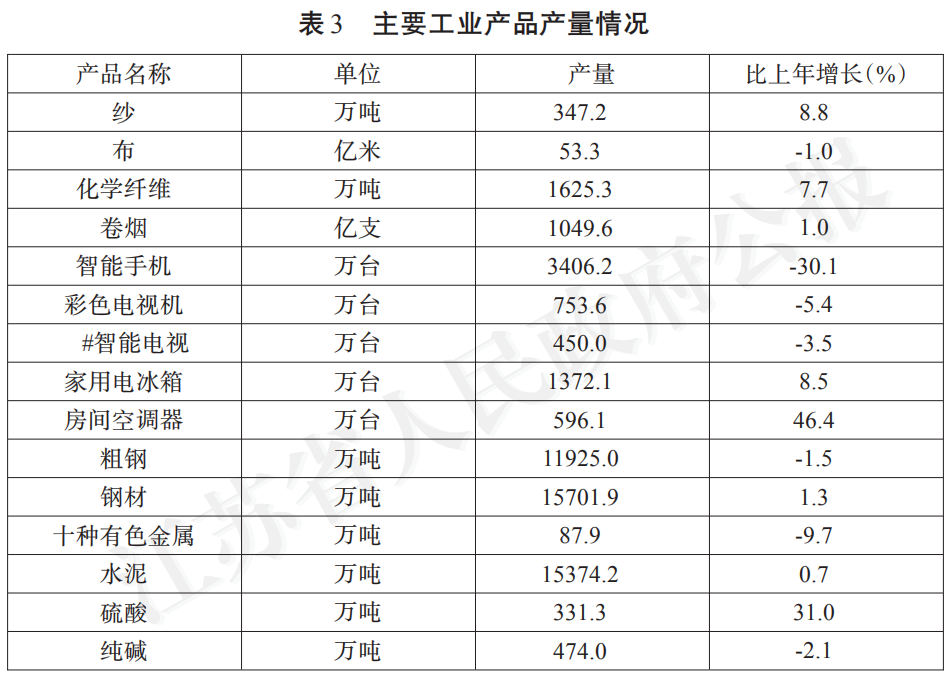
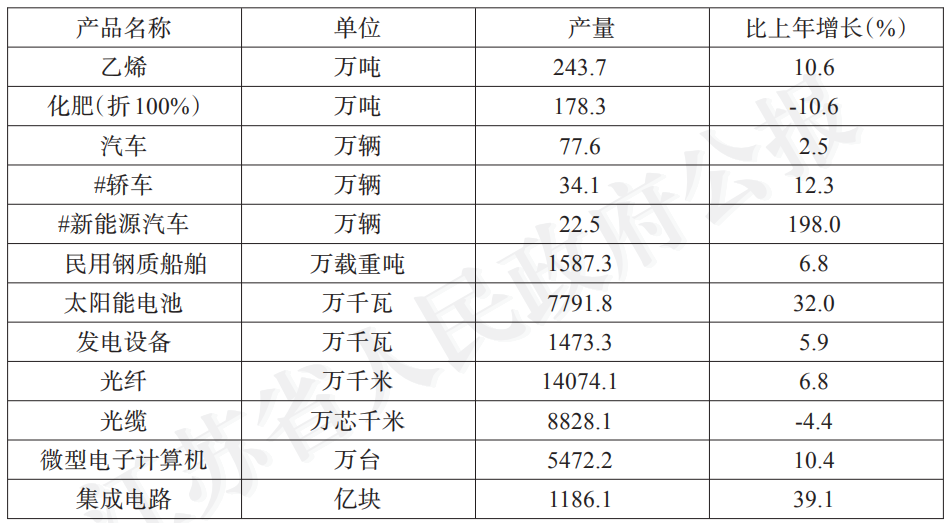
 

The profitability of industrial enterprises has improved. The total profits of industrial enterprises above designated size reached 935.81 billion yuan, an increase of 25.7% over the previous year. In terms of economic types, the profit of state-owned holding enterprises was 137.03 billion yuan, an increase of 37.7%; 670 million yuan for collective enterprises, an increase of 54.9%; Joint-stock enterprises reached 550.71 billion yuan, an increase of 30.4%; Foreign investors and Hong Kong, Macao and Taiwan businessmen invested 368.15 billion yuan, an increase of 19.9%; Private enterprises reached 336.12 billion yuan, an increase of 30.6%. In terms of categories, the profit of the mining industry was 1.89 billion yuan, an increase of 3.2% over the previous year; The manufacturing industry was 907.20 billion yuan, an increase of 30.5%; Electricity, heat, gas and water production and supply industries reached 26.73 billion yuan, down 43.6%. The operating income profit rate and cost profit rate of industrial enterprises above designated size were 6.2% and 6.7%, respectively, 0.2 and 0.3 percentage points higher than the previous year. The annual production and sales rate of industrial enterprises above designated size reached 98.2%.

The construction industry has developed steadily and healthily. The amount of construction contracts signed in the whole year was 6,144.30 billion yuan, an increase of 5.8% over the previous year; The total output value of the construction industry was 3,824.45 billion yuan, an increase of 8.5% over the previous year; The completed output value was 2,706.37 billion yuan, an increase of 6.2%, and the completion rate reached 70.8%. The labor productivity of the construction industry was 369,000 yuan/person, an increase of 2.1% over the previous year.

IV. Investment in fixed assets

The growth rate of investment has steadily increased. Annual investment in fixed assets increased by 5.8% over the previous year. Among them, state-owned and state-owned economy holding investment increased by 3.1%, and foreign investment and investment from Hong Kong, Macao and Taiwan businessmen increased by 7.2%. Private investment increased by 6.3%, accounting for 69.2% of the total investment. By type, project investment increased by 7.6%, and real estate development investment increased by 2.3%. The annual sales area of commercial housing was 165.518 million square meters, an increase of 7.3% over the previous year. Among them, the residential sales area was 143.615 million square meters, an increase of 3.7%.

The investment structure was continuously optimized. The annual investment in high-tech industries increased by 21.6% over the previous year, and the growth rate was 15.8 percentage points higher than the total investment, driving the total investment to increase by 3.5 percentage points. Among the major industries, the investment in medical equipment and instrument manufacturing, electronic and communication equipment manufacturing, pharmaceutical manufacturing, information services and other industries grew rapidly, with an increase of 25.6%, 21.5%, 14.6% and 15.7% respectively. Investment in manufacturing industry increased by 16.1%, which was 10.3 percentage points higher than the growth rate of total investment, driving the growth rate of total investment by 6 percentage points. Among the investment in service industry, investment in information transmission software and information technology service industry increased by 27.8%, investment in scientific research and technology service industry increased by 24.9%, and investment in health and social work increased by 18%.

V. Domestic trade

The consumer goods market recovered steadily. The total retail sales of consumer goods in the whole year was 4,270.26 billion yuan, an increase of 15.1% over the previous year. According to business statistics, the retail sales of urban consumer goods reached 3,785.02 billion yuan, up by 13.6%. The retail sales of rural consumer goods reached 485.24 billion yuan, an increase of 28.9%. Among the retail sales of commodities above designated size in the whole year, the sales of basic necessities increased steadily, and the daily necessities, clothing, shoes, hats, needles, textiles, cereals, oils and foodstuffs increased by 22.6%, 16.7% and 16.0% respectively. Upgraded consumer demand continued to be released, with sports and entertainment products, smart household appliances and audio-visual equipment, smart phones, gold and silver jewelry increasing by 39.8%, 35.2%, 25.9% and 22.4% respectively; Travel sales maintained a steady momentum, with oil, products and automobiles increasing by 26.6% and 9.9% respectively, among which new energy vehicles increased by 105.4%. The annual online retail sales of physical goods reached 952.7 billion yuan, up 5.2% over the previous year, accounting for 22.3% of the total retail sales of social consumer goods.

VI. Open economy

Foreign trade maintained rapid growth. The total import and export volume reached 5,213.06 billion yuan, up by 17.1% over the previous year. Among them, the export was 3,253.23 billion yuan, an increase of 18.6%; Imports reached 1,959.83 billion yuan, up by 14.8%. From the perspective of trade mode, the total import and export volume of general trade was 2,932.83 billion yuan, an increase of 23.3%; It accounts for 56.3% of the total import and export, exceeding the processing trade by 24.7 percentage points. From the perspective of export subjects, the export volume of state-owned enterprises, foreign-funded enterprises and private enterprises increased by 22.4%, 11.4% and 27.7% respectively. From the export market, exports to the United States, the European Union and Japan increased by 14.4%, 21.9% and 6.3% respectively, while exports to India, Russia and ASEAN increased by 38%, 38.2% and 15.7% respectively. From the perspective of export products, the export volume of electromechanical and high-tech products increased by 17.8% and 10.4% respectively. Exports to countries along the "Belt and Road" maintained rapid growth, with an export value of 892.49 billion yuan, an increase of 20.8%; It accounts for 27.4% of the province’s total exports and contributes 30.1% to the province’s export growth.
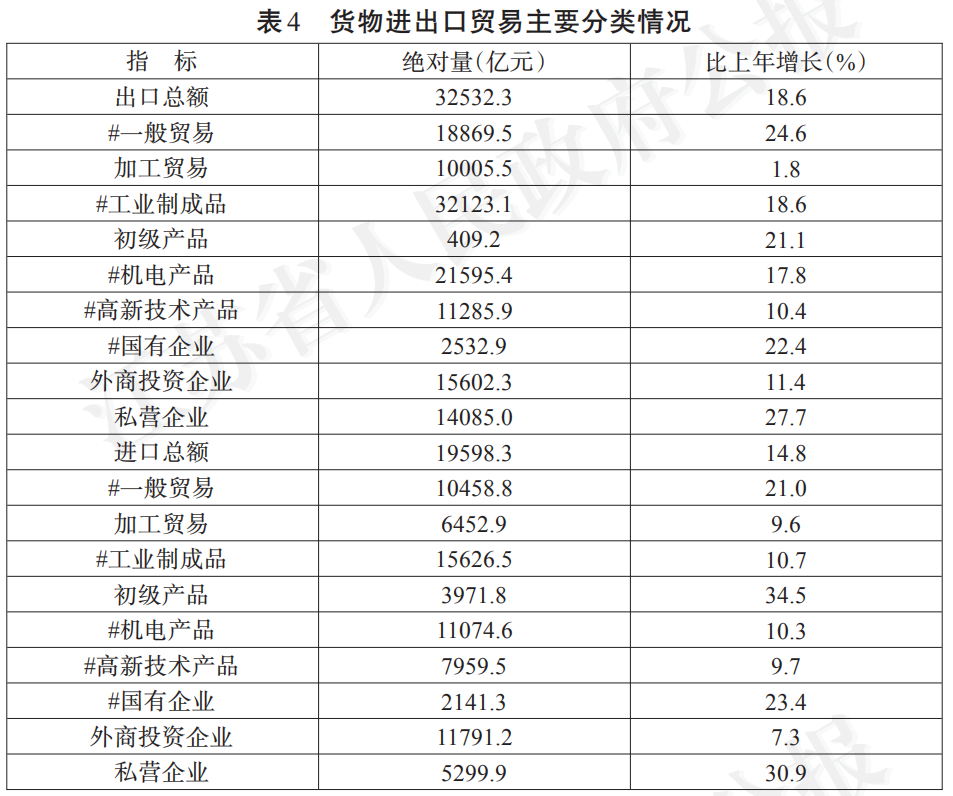
 

The utilization of foreign capital has increased steadily. In the whole year, 4,237 foreign-invested enterprises were newly established, an increase of 18.6% over the previous year; The actually used foreign capital was US$ 28.85 billion, up by 22.7%. In the whole year, 726 overseas investment projects were newly approved, with an agreed investment of US$ 6.68 billion from China. The contract value of newly signed foreign contracted projects was US$ 5.59 billion, and the turnover of newly signed foreign contracted projects was US$ 5.95 billion. Promote the construction of the "Belt and Road" intersection, and add 191 foreign investment projects along the "Belt and Road" throughout the year, with an agreed investment of US$ 1.59 billion from China.

VII. Transportation, Posts and Telecommunications and Tourism

The transportation industry is generally stable. The transportation volume of goods completed by five modes of transportation in the province, such as Tiegong Water and Air Traffic Control, increased by 6.5% compared with the previous year, and the turnover of goods increased by 7.8%; Passenger traffic decreased by 22.5%, and passenger turnover increased by 5.1%. The province’s airport aircraft took off and landed 437,000 times, down 1.8% from the previous year; The passenger throughput was 39.414 million passengers, an increase of 0.5%; The cargo and mail throughput was 653,000 tons, down 2.8%. The port throughput of the province was 3.21 billion tons, up by 8.2% over the previous year, of which the foreign trade cargo throughput was 590 million tons, up by 6.6%. The container throughput was 21.801 million TEUs, up by 15%. At the end of the year, the province’s highway mileage was 159,000 kilometers, an increase of 414 kilometers over the end of the previous year, of which the expressway mileage was 5,028 kilometers. The operating mileage of railways is 4,221.9 kilometers, of which the mileage of high-speed railways is 2,212 kilometers, an increase of 191 kilometers over the previous year; The extension length of the main railway line is 7591.7 kilometers, an increase of 366.3 kilometers over the previous year. At the end of the year, the number of civilian vehicles was 21.87 million, an increase of 7% over the end of last year, with a net increase of 1.426 million. At the end of the year, the number of private cars was 18.627 million, an increase of 6.6% over the end of the previous year, with a net increase of 1.148 million; Among them, the number of private cars was 12.535 million, an increase of 5.5% and a net increase of 905,000.
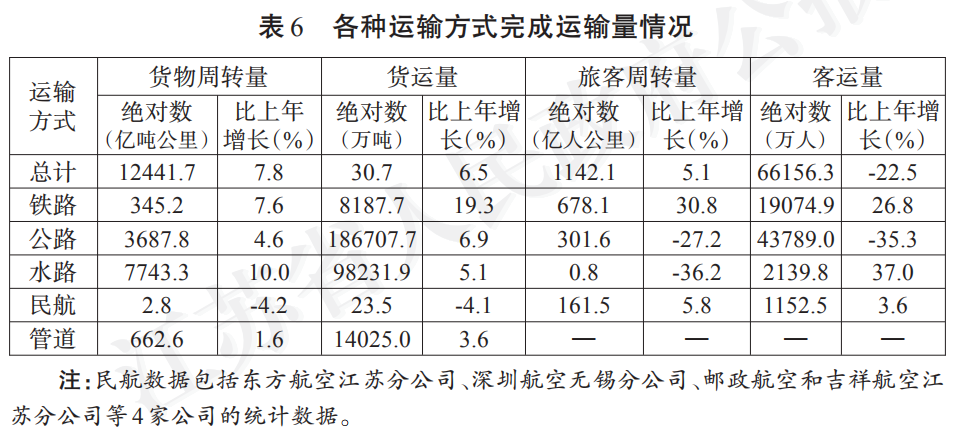
 

The postal telecommunications industry has developed rapidly. The total business volume of the postal and telecommunications industry in 2001 was 227.01 billion yuan, an increase of 25.9% over the previous year; The business income was 213.66 billion yuan, an increase of 9.6%. In terms of industries, the postal industry completed a total business of 97.27 billion yuan, an increase of 20%; The business income was 100.11 billion yuan, an increase of 8.9%. Among them, the express delivery industry completed 8.61 billion pieces of business, an increase of 23.4%. The total business volume of the telecommunications industry was 129.75 billion yuan, an increase of 30.8% over the previous year; The business income was 113.55 billion yuan, an increase of 10.3%. At the end of the year, there were 12.505 million fixed-line users, a decrease of 599,000 from the end of the previous year; At the end of the year, there were 101.795 million mobile phone users, with a net increase of 2.824 million; The telephone penetration rate reached 134.3 units per 100 people. At the end of the year, the total length of long-distance optical cable lines was 39,600 kilometers, a decrease of 856.4 kilometers compared with the end of the previous year; At the end of the year, there were 40.716 million Internet broadband access users, an increase of 8.4% over the end of the previous year, with a net increase of 3.148 million. The transmission traffic of mobile Internet was 146.1 trillion GB, an increase of 33.9%.

Tourism has recovered rapidly. In the whole year, it received 710 million domestic and foreign tourists, an increase of 49.6% over the previous year; The total tourism revenue was 1,167.27 billion yuan, an increase of 41.5%. Received 619,000 overnight visitors, down 19.7%. Among them, there were 398,000 foreigners, a decrease of 23%; There were 221,000 compatriots from Hong Kong, Macao and Taiwan, down by 12.9%. Foreign exchange income from tourism was $1.14 billion, down 31%. Domestic tourism has grown rapidly. Received 710 million domestic tourists, an increase of 49.7% over the previous year; Domestic tourism revenue reached 1,159.39 billion yuan, an increase of 42.5%.

Eight, finance, finance

Fiscal revenue exceeded one trillion yuan. In the whole year, the general public budget revenue was 1,001.52 billion yuan, an increase of 10.6% over the previous year; Among them, tax revenue was 817.13 billion yuan, an increase of 10.2%; Tax revenue accounted for 81.6% of the general public budget revenue, and continued to maintain a high level.
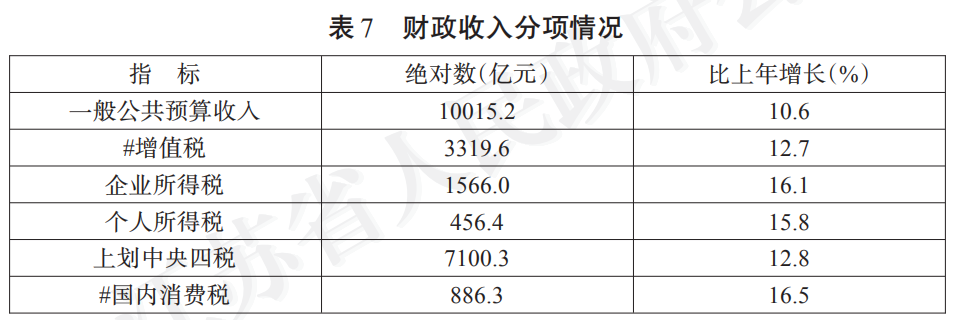
 

The expenditure structure continued to improve. The annual general public budget expenditure was 1,458.60 billion yuan, an increase of 6.6% over the previous year. Of the general public budget expenditure, education expenditure was 256.21 billion yuan, an increase of 6.5%; Public security expenditure was 90.84 billion yuan, up by 2.7%; Health expenditure was 118.27 billion yuan, an increase of 17.4%; Expenditure on social security and employment was 189.56 billion yuan, an increase of 6.5%; Expenditure on housing security was 77.78 billion yuan, up by 17.6%.

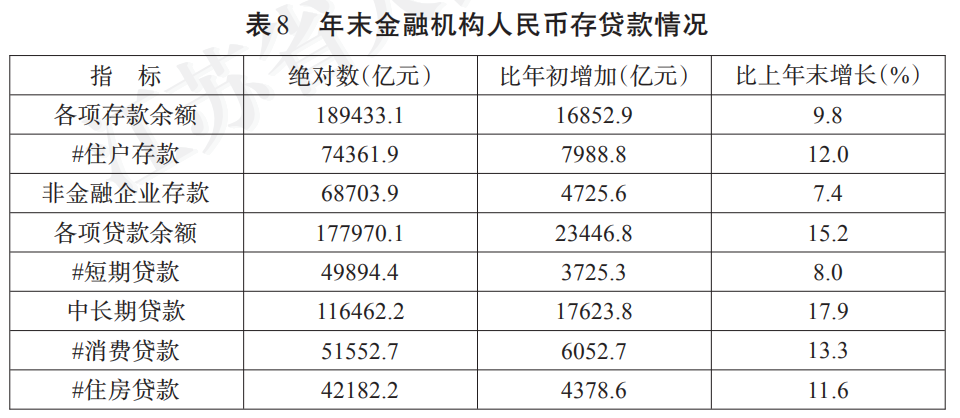
The scale of financial credit has expanded. At the end of the year, the balance of RMB deposits in financial institutions in the province was 18,943.31 billion yuan, an increase of 9.8% over the end of last year and 1,685.29 billion yuan over the beginning of the year. Among them, household deposits increased by 798.88 billion yuan, and non-financial enterprise deposits increased by 472.56 billion yuan. At the end of the year, the balance of RMB loans of financial institutions was 17,797.01 billion yuan, an increase of 15.2% over the end of the previous year and an increase of 2,344.68 billion yuan over the beginning of the year. Among them, medium and long-term loans increased by 1,762.38 billion yuan and short-term loans increased by 372.53 billion yuan.
 

The securities market developed rapidly. At the end of the year, there were 571 listed companies and 380 counseling enterprises in the province, and enterprises in the province raised 757.82 billion yuan in the capital market through issuance, rights issue, additional issuance and corporate bonds. The total share capital of listed companies in Jiangsu enterprises was 447.44 billion shares, up by 6.0% over the previous year. The total market value was 7,553.75 billion yuan, an increase of 20.3%. At the end of the year, there were 6 securities companies and 1035 securities business departments in the province. There are 9 futures brokerage companies and 193 business departments of futures brokerage companies; There are 3 securities investment consulting institutions. The annual securities transaction volume was 100.2 trillion yuan, up by 13.0% over the previous year. In the whole year, the agency transaction volume of futures operating institutions was 32.7 trillion yuan, an increase of 63.4% over the previous year.

The insurance industry grew steadily. The annual premium income was 405.11 billion yuan, an increase of 5.2% over the previous year. In terms of types, property insurance income was 100.22 billion yuan, an increase of 2.3%; Life insurance income was 234.50 billion yuan, up by 5.5%; Health insurance income was 60.96 billion yuan, an increase of 8.8%; Accidental injury insurance income was 9.44 billion yuan, an increase of 10.3%. The annual compensation expenditure was 125.48 billion yuan, an increase of 18.4% over the previous year. Among them, property insurance paid 62.58 billion yuan, an increase of 12.5%; Life insurance payment was 25.73 billion yuan, down by 8.7%; Health insurance paid 34.54 billion yuan, an increase of 74.4%; Accidental injury insurance paid 2.63 billion yuan, down 9.3%.

IX. Science, Technology and Education

The ability of scientific and technological innovation has been continuously enhanced. The number of patents granted in the province was 641,000, an increase of 28.4% over the previous year, including 69,000 invention patents, an increase of 49.7%; The number of PCT patent applications was 7,168, down by 25.4%. At the end of the year, the number of valid invention patents in the province was 349,000, an increase of 19.7% over the end of last year; The number of invention patents per 10,000 people was 41.2, an increase of 13.9%. The contribution rate of scientific and technological progress was 66.1%, an increase of 1 percentage point over the previous year. In the whole year, 83,000 technical contracts were signed, and the turnover of technical contracts reached 301.36 billion yuan, an increase of 29% over the previous year. There are 1075 creative spaces at or above the provincial level.

The development of high-tech industries has accelerated. Integrated implementation of 225 industrial foresight and key core technology research and development, major scientific and technological achievements transformation projects, breaking through a number of industrial technology bottlenecks. At that time, it was recognized that there were more than 12,000 national high-tech enterprises and 163 national enterprise R&D institutions, ranking among the top in the country. The province has built 172 national high-tech characteristic industrial bases.

Investment in scientific research has increased. The expenditure of research and experimental development (R&D) activities in the whole society accounts for 2.95% of the regional GDP, and there are 924,000 R&D personnel. The province has 118 academicians from China Academy of Sciences and China Academy of Engineering. Among various scientific research and technology development institutions, there are 446 independent research and development institutions of government departments. We will build 186 national and provincial key laboratories, 260 public service platforms for science and technology at or above the provincial level, 4,464 engineering technology research centers, 144 academician workstations and 2 nationally recognized technological innovation centers.

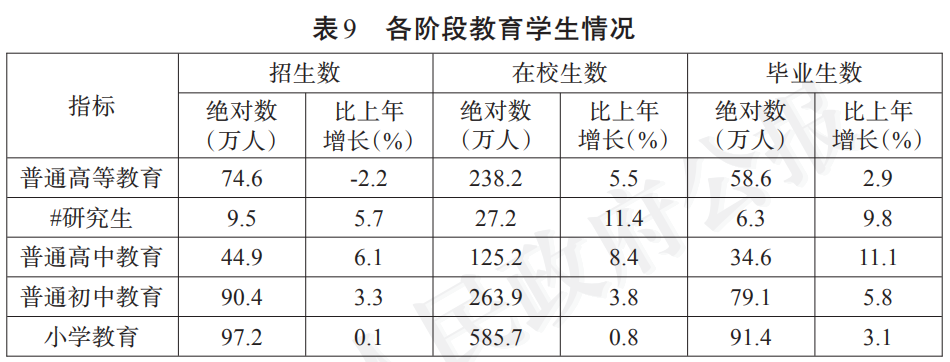
Education has developed in an all-round way. There are 168 colleges and universities (including independent colleges) in the province. General higher education has 652,000 students enrolled, 2.111 million students enrolled and 524,000 graduates. There are 95,000 graduate students enrolled, 272,000 students enrolled and 63,000 graduates. The number of students in secondary vocational education in the province is 641,000 (excluding technical schools). Special education schools enrolled 3,000 students and enrolled 20,000 students. There are 8,116 kindergartens in the province, an increase of 213 over the previous year; There were 2.525 million children in the park, 16,000 fewer than the previous year.
 

X. Culture, Health and Sports

The level of public cultural services has been continuously improved. The urban and rural public cultural service system has been continuously improved. There are 116 cultural centers and mass art galleries, 122 public libraries, 366 museums, 48 art galleries and 112 comprehensive archives in the province, and 3.413 million volumes of archives are open to the public. There are 4 radio stations, 4 TV stations, 10 radio and TV stations, and 21 medium and short-wave radio transmitting stations and relay stations, and the comprehensive population coverage of radio and television is 100%. There are 13.843 million cable TV users in the province. Production of 12 TV series with 433 episodes throughout the year; Review 36 films, including 31 story films, 3 documentary films and 2 animated films; 1.87 billion newspapers, 120 million periodicals and 730 million books were published.

Health undertakings have been steadily advanced. At the end of the year, there were 36,446 health institutions in the province. Among them, there are 2029 hospitals, 115 centers for disease control and prevention, and 118 maternal and child health care institutions. Various health institutions have 548,000 beds, of which hospitals have 429,000 beds. There are 688,000 health technicians, including 272,000 medical practitioners and assistant medical practitioners, 308,000 registered nurses, 9,000 health technicians from the Centers for Disease Control and Prevention, and 18,000 health technicians from maternal and child health care institutions.

Sports are developing vigorously. Mass sports and competitive sports, sports undertakings and sports industries have developed in a coordinated way, and Jiangsu athletes have achieved excellent results in the Tokyo Olympic Games and the 14th National Games. At the Tokyo Olympic Games, two people won two gold medals, six people won five silver medals and two people won two bronze medals, setting a world record and an Olympic record. Won 42 gold medals, 35 silver medals and 39 bronze medals in the 14th National Games, breaking 2 national records. In other world top-level competitions (except the Olympic Games), 7 people won 3 gold medals, 5 people won 3 silver medals and 3 people won 3 bronze medals.

XI. Environmental protection

The battle against pollution has achieved remarkable results. The quality of ecological environment has been the best since the century. The average annual concentration of PM2.5 in the province was 33 μ g/m3, down by 13.2% year-on-year, and the ratio of days with excellent air quality reached 82.4%, up by 1.8 percentage points year-on-year. For the first time, the province reached the second-class national air quality standard, achieving a historic breakthrough. In the national examination of water environment, the proportion of excellent section III was 87.1%, up by 3.8 percentage points year-on-year, and the inferior class V water was completely eliminated, which exceeded the national assessment task. Taihu Lake has been treated for 14 consecutive years to achieve "two guarantees" of safe drinking water and no large-scale flooding. The excellent proportion of seawater in coastal waters increased significantly year-on-year, and the excellent proportion of seawater in coastal waters in the province was 87.4%, up 41.1 percentage points year-on-year; The proportion of inferior four types of seawater was 17%, a year-on-year decrease of 7.9 percentage points. Detailed investigation of soil pollution was completed. The protection and restoration of the ecological environment of the Yangtze River has been solidly promoted, and the strategic orientation of "jointly protecting and not developing" has been firmly grasped, and the results of shoreline improvement along the Yangtze River have been consolidated and improved. The water quality of Jiangsu section of the main stream of the Yangtze River has remained Class II, and the proportion of natural coastline has increased to 73.2%.

The urban and rural environment was further optimized. The province’s forest coverage rate reached 24%, the number of national demonstration zones for ecological civilization construction increased to 27, and the number of rural villages with provincial characteristics increased to 446, and 9 national ecological garden cities were built, ranking first in the country. Vigorously promote the transformation and upgrading of the chemical, steel, coal and electricity industry and optimize the layout, and close 354 chemical production enterprises that have withdrawn from low-end backward and environmentally sensitive areas.

XII. Population, People’s Life and Social Security

The total population keeps growing. At the end of the year, the resident population of the province was 85.054 million, an increase of 281,000, or 0.3%. Among the permanent residents, there are 43.162 million males and 41.892 million females. There are 12.494 million people aged 0-14, 58.064 million people aged 15-64, and 14.496 million people aged 65 and above. The annual birth rate was 5.7‰, down 1.0 thousandths over the previous year; The population mortality rate was 6.8‰, up by 0.3 per thousand points over the previous year; The natural population growth rate was -1.1‰, down by 1.3 thousandths over the previous year. The pace of new urbanization was accelerated. At the end of the year, the urbanization rate of permanent residents reached 73.94%, an increase of 0.5 percentage points over the end of last year.

Residents’ income grew steadily. According to the household survey of urban-rural integration, the per capita disposable income of residents in the province was 47,498 yuan, an increase of 9.5% over the previous year. Among them, wage income was 26,721 yuan, an increase of 8.4%; The net operating income was 6,215 yuan, an increase of 9.0%; The net income of property was 5,316 yuan, an increase of 12.2%; The net transfer income was 9247 yuan, an increase of 11.5%. According to the place of permanent residence, the per capita disposable income of urban residents was 57,743 yuan, an increase of 8.7%; The per capita disposable income of rural residents was 26,791 yuan, up by 10.7%. The income gap between urban and rural residents has further narrowed, and the income ratio between urban and rural residents has narrowed from 2.19:1 in the previous year to 2.16:1. The per capita consumption expenditure of residents in the province was 31,451 yuan, an increase of 19.9% over the previous year. According to the place of permanent residence, the per capita consumption expenditure of urban residents was 36,558 yuan, an increase of 18.4%; The per capita consumption expenditure of rural residents was 21,130 yuan, an increase of 24.1%.

The social security system is more perfect. The per capita basic pension for retirees has increased by 4.5%, unemployment insurance has been further expanded and raised, basic medical insurance has been fully realized at the municipal level, and the basic livelihood of people in need has been better guaranteed. The number of people participating in urban and rural basic old-age pension, unemployment insurance and work-related injury insurance reached 59.64 million, 19.67 million and 23.407 million respectively, and the number of people receiving unemployment insurance was 292,000, down 12.1% from the end of last year. The number of people who participated in the basic medical insurance for urban and rural residents was 48.178 million, and the number of people who participated in the basic medical insurance for employees was 32.46 million. The participation rate of urban and rural basic medical insurance reached 98.5%, an increase of 0.5 percentage points over the same period of last year.

Social services are improving day by day. At the end of the year, there were 3,639 social service institutions providing accommodation in the province, including 2,494 institutions for the aged and 44 institutions for children. There are 455,000 social service beds, including 440,000 beds for the aged and 0.4 million beds for children. By the end of the year, there were 2,971 community service centers and 13,000 community service stations.

Note:

[1] The data used in this bulletin are express numbers.

[2] The growth rate of regional GDP, industrial added value above designated size and its classified projects is calculated at comparable prices, which is the actual growth rate; Other indicators, unless otherwise specified, are calculated at current prices and are nominal growth rates.

[3] The proportion of expenditure on research and experimental development (R&D) activities in regional GDP is estimated.

[4] Due to rounding of some data, the total is not equal to the sub-total.

[5] Some index data are not comparable to the previous year due to the adjustment of statistical caliber.

Browse and download the PDF version of the bulletin:Statistical Bulletin on National Economic and Social Development of Jiangsu Province in 2021. pdf

The hot tourism market in the Spring Festival and the rapid growth of service consumption outline a new picture of China’s economic vitality.

  Cctv newsOn February 18th, "News Network" reported that during the Spring Festival holiday, the consumption boom highlighted the economic vitality of China, with over 1.7 billion express parcels nationwide. At the same time, China’s spring ploughing and spring management began from south to north … … A number of economic and social development data show that the popularity of the north and south of the motherland is strong, the tourism market is hot, and the service consumption is growing, which outlines a new picture of China’s economic vitality.

  During the Spring Festival holiday, there were 474 million domestic tourists.

  On February 18th, the Ministry of Culture and Tourism announced that during the Spring Festival holiday this year, there were 474 million domestic tourists, up 34.3% year-on-year, and 19.0% compared with the same period in 2019. The total spending of domestic tourists on trips was 632.687 billion yuan, a year-on-year increase of 47.3% and an increase of 7.7% over the same period in 2019. There were about 6.83 million inbound and outbound tourists, including 3.6 million outbound tourists and 3.23 million inbound tourists.

  According to big data analysis, in the Spring Festival holiday this year, from the perspective of travel distance, short-distance travel within 200 kilometers accounted for 33%, medium-distance travel from 200 kilometers to 500 kilometers accounted for 31%, and long-distance travel over 500 kilometers accounted for 36%. In terms of the number of days of travel, the number of people traveling for three days or more accounts for the highest proportion, reaching 58%.

  The data shows that the popularity of ice and snow tourism continues to rise, and visiting museums during holidays is becoming a new trend, and the highlights of garden activities are frequent everywhere.

  The average daily sales revenue of service consumer industry increased by 52.3% during the Spring Festival holiday.

  On February 18th, State Taxation Administration of The People’s Republic of China released the news. According to the data of VAT invoice, during the Spring Festival holiday this year, the average daily sales revenue of service-related industries in China increased by 52.3% year-on-year, and the consumption of tourism, accommodation and catering services increased rapidly.

  Specifically, driven by the fiery tourism market, the average daily sales revenue of travel agencies and related services increased by 1.2 times year-on-year, the average daily sales revenue of tourism and leisure services increased by 70% and 40% respectively, and the average daily sales revenue of air travel services and car rental services increased by 71% and 1.4 times respectively.

  Driven by the demand for returning home during the Spring Festival and traveling, the average daily sales revenue of accommodation services increased by 25.4% year-on-year, among which the average daily sales revenue of economy hotel chains and tourist hotels increased by 35.2% and 11.5% year-on-year, respectively. The average daily sales revenue of B&B services increased by 68.8% year-on-year. The average daily sales revenue of catering services increased by 31.5% year-on-year.

  At the same time, the popularity of cultural and sports services has increased. The average daily sales revenue of cultural and artistic services increased by 86.7% year-on-year. The average daily sales revenue of sports services increased by 43.2% year-on-year.

  During the Spring Festival holiday, the national box office was 8.016 billion yuan.

  On February 18th, the National Film Bureau released a message. According to preliminary statistics, the box office of movies nationwide this year during the Spring Festival holiday was 8.016 billion yuan, and the number of people watching movies was 163 million, which increased by 18.47% and 26.36% respectively compared with that during the Spring Festival holiday in 2023, both of which set new records in the same period.

  13.517 million people entered and exited the country during the Spring Festival holiday.

  On February 18th, the National Immigration Bureau announced that 13.517 million people entered and exited the country during the Spring Festival holiday this year, with an average of 1.69 million person-times per day, returning to nearly 90% in the same period of the Spring Festival in 2019.

  During the Spring Festival holiday, more than 1.7 billion express parcels were collected nationwide.

  According to the latest data released by the State Post Bureau, during the Spring Festival holiday this year (February 10th to 17th), 1.079 billion express parcels were collected nationwide, and the average daily collection increased by 145.2% compared with the Spring Festival holiday in 2023. 641 million express parcels were delivered, and the average daily delivery volume increased by 82.1% compared with the Spring Festival holiday in 2023.

  In China, spring ploughing and spring pipes are gradually launched from south to north.

  The area of spring sown grain accounts for more than half of the whole year. According to the agricultural dispatch of the Ministry of Agriculture and Rural Affairs, early rice in South China began to soak seeds and raise seedlings one after another. In addition, winter wheat is the main variety of summer grain, and now it has entered a critical period of field management. At present, the soil moisture in the main wheat producing areas is the best in the past decade, which is conducive to the safe overwintering and green growth of wheat.

  Hengqin Guangdong-Macao Deep Cooperation Zone will be closed for operation on March 1st.

  Since 0: 00 on March 1st, Hengqin Guangdong-Macao Deep Cooperation Zone will be officially closed for operation. On February 17th, the way of personnel and vehicles leaving the island in each "second-line" channel of Hengqin Guangdong-Macao Deep Cooperation Zone was announced.

  The operation of customs clearance is a landmark measure to achieve the development goal of the first phase of the cooperation zone, and it is also an important step to promote the integration of Qin and Macao. At present, the cooperation zone is sprinting towards the goal of closing the whole island, and relevant policies have been issued one after another, which will be implemented on the day when the relevant regulatory facilities in the cooperation zone pass the inspection and are officially closed.

  "Deep Sea No.1" Phase II comprehensive processing platform carries out offshore hoisting operation.

  On February 18th, the offshore production blocks and ancillary facilities of "Deep Sea No.1" Phase II comprehensive processing platform began to be hoisted at sea. After the second phase of the "Deep Sea No.1" project is fully put into operation, the annual natural gas output of the "Deep Sea No.1" gas field will be increased from the current 3 billion cubic meters to 4.5 billion cubic meters, greatly enhancing the ability of the "Deep Sea No.1" gas field to supply natural gas to Guangdong-Hong Kong-Macao Greater Bay Area.

  The second phase expansion project of Fuzhou Changle International Airport was accelerated.

  Recently, the underground works of the new terminal of the second phase expansion project of Fuzhou Changle International Airport have all been completed, and at the same time, the above-ground works, flight area works, air traffic control works and other supporting projects have been accelerated.

  It is understood that the second phase expansion project of Fuzhou Changle International Airport is expected to be completed in 2026. After completion, the annual passenger throughput of Fuzhou Changle International Airport will reach 36 million passengers and the cargo and mail throughput will reach 450,000 tons, which is of great significance for building an important hub node of the national comprehensive three-dimensional transportation network and promoting the economic and social development of Fuzhou metropolitan area.

  Domestic large aircraft made its debut abroad for the first time.

  Two C919 aircraft and three ARJ21 aircraft participating in the 2024 Singapore Air Show all arrived in Singapore on February 17th, which was the first time that a large domestic aircraft appeared abroad. During the air show, five domestic commercial aircraft will meet the public, and the C919 and ARJ21 aircraft will perform an air show.

Sudden hypothermia at 41℃! Beware of temperature loss in summer →

Summer heat dissipation

Drifting has become the first choice for many people to travel.

In the process of drifting

It will be extremely cool if the clothes are wet by the river.

But also beware of hypothermia.

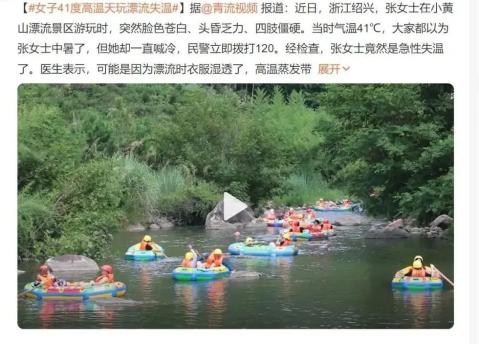
There were news reports earlier.

When a woman was playing in a drifting scenic spot,

Suddenly pale and stiff limbs

The temperature was 41℃

Everyone thought it was heatstroke.

After inspection, it was found that it was acute hypothermia.

Why does it lose temperature in summer?

What are the symptoms of hypothermia?

How to deal with this situation?

↓↓↓

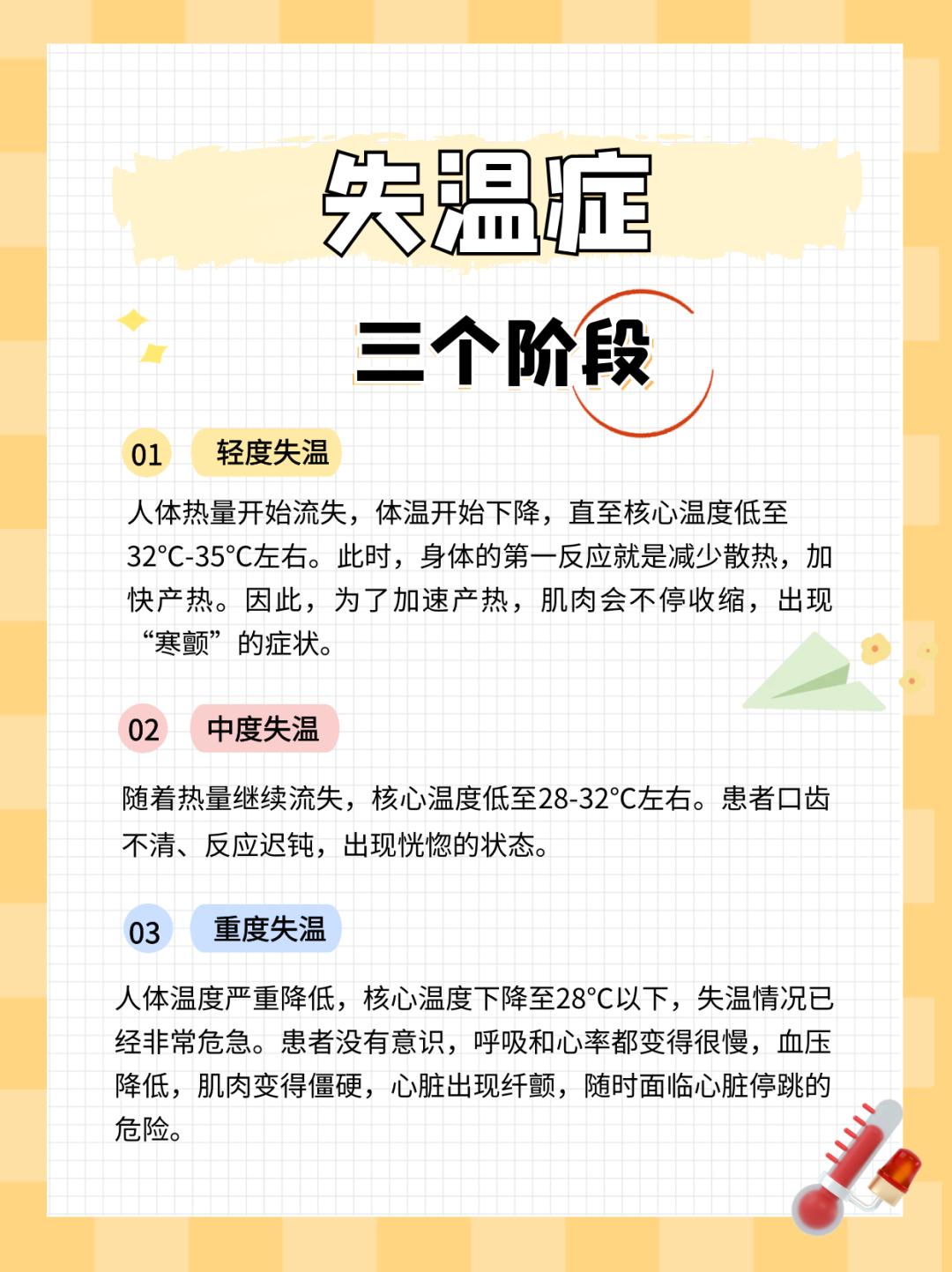
What is temperature loss?

Loss of temperature, in short, is the phenomenon that the body’s temperature regulation is unbalanced, and the heat production is lower than the heat dissipation, which leads to the gradual loss of human heat and the inability to maintain normal body temperature.

generally speaking

Hypothermia has three stages of development.

thus it can be seen that

The danger of hypothermia should not be underestimated.

It has been reported that from 2000 to 2019, inappropriate outdoor temperature was associated with more than 5 million extra deaths each year, accounting for 9.43% of the total deaths in the world, of which 8.52% were caused by low temperature, so some people also called hypothermia a "silent death".

Why does it lose temperature in summer?

The human body itself is a pyrogen, which transfers heat with the outside world at any time and place, among which temperature, humidity and wind force are the most common factors leading to temperature loss.

Even in summer, there will be a temperature difference between morning and evening. Because the river water soaks clothes when drifting, and then it is blown by the wind, the evaporation of water will quickly lose heat, causing temperature loss, not to mention the extreme weather.

How to treat temperature loss?

Get out of low temperature and transfer safely: when someone has symptoms of hypothermia, the patient should be removed from the low temperature environment immediately and transferred to a warm, sheltered and safe environment.

Judge the degree of hypothermia and give first aid in time: judge the temperature loss according to the patient’s state, and take corresponding first aid measures or dial 120 according to the severity of his symptoms.

Keep dry, core heating: check the clothes of those who have lost temperature and replace the wet clothes as soon as possible. At the same time, use warm-keeping equipment, such as hot water bottles, heating stickers, etc. to heat the core parts of those who have lost temperature. It should be noted that only the core is heated, and never use rubbing hands and feet to heat the limbs, otherwise it will lead to cold blood flowing back to the heart and may cause cardiac arrest.

Eat properly and input energy: let people with hypothermia eat some high-calorie and easy-to-eat liquid food, so that they can quickly replenish energy.

Safety secant line

@ emergency people:

What else do you know?

Popular science cold knowledge, emergency small coup

[eagerly looking forward to your contribution]

hbyjglxjzx@163.com

Once adopted, there will be repercussions.

Welcome to Liao

Original title: "Sudden hypothermia at 41 C! Beware of temperature loss in summer →

Read the original text